
Last updated on September 20, 2026
I went into Active Matter without many expectations, just curious about a game I kept hearing had recently left early access and landed on Steam, published by Gaijin Network, the studio behind War Thunder. I played my first real hours with two friends, and everything below is built on that hands-on experience, not on what the store page promises.
I split my impressions across the three areas that matter most: PvE raids, the PvP Hired Ops mode, and everything base related, meaning Refiner, Replicator, and the rest of the systems.
PvE: too much loot, too little time to think
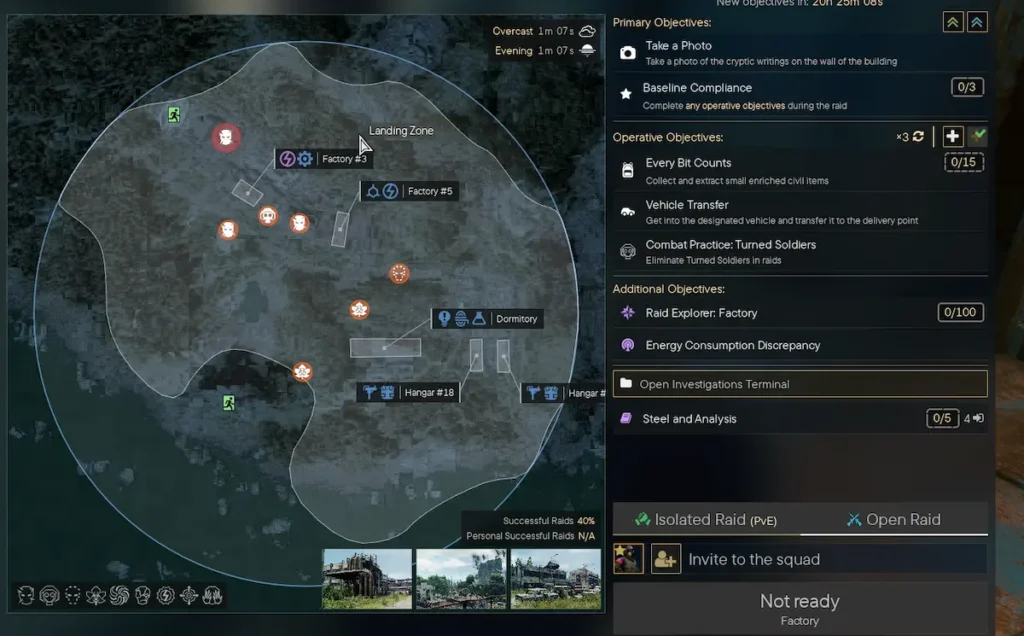
We started a raid as a squad of three. Cars parked along the road have loot in their trunks, which isn’t something the game tells you directly, but if you’ve played other extraction shooters or looter games before, checking car trunks is just instinct by now. Houses are stuffed with small loot: needles, matches, keys, bits of plastic, old boxes of who knows what.
You pick up everything at first, because you don’t know yet what you’ll actually need. Then your inventory fills up fast, and you’re forced to decide what to drop or leave behind, often while standing in the open with no idea when or where a monster might show up next.
Every item shows exactly what it’s worth if refined, down to how many points of metal or fiber it gives, but you can’t actually refine anything on the spot. Everything has to be carried all the way back to base first, decisions and all.
Combat is genuinely hardcore, and it shows
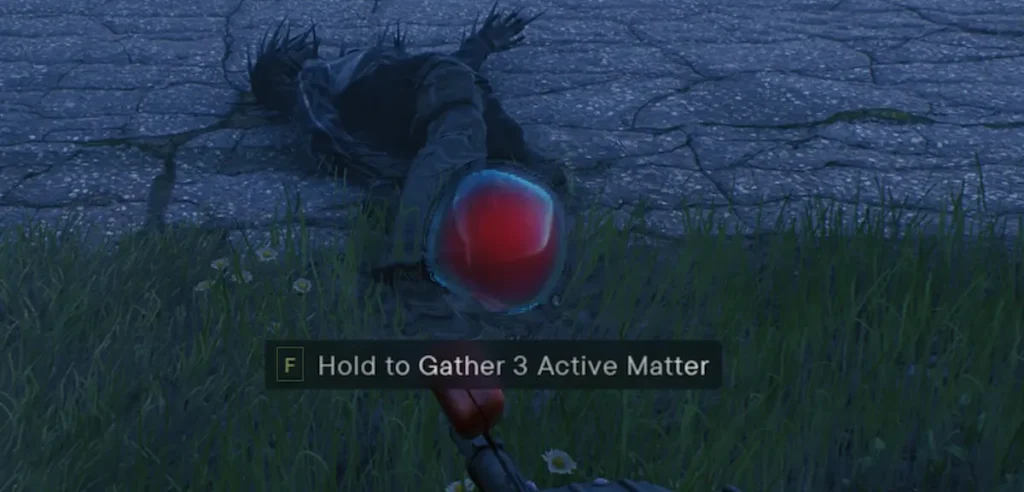
Monsters here are unpredictable. Some lunge straight at you, others vanish and reappear somewhere else entirely. We also ran into stone statues that seemed harmless at first, until we realized they move and attack exactly when you’re not looking at them, and freeze in place the moment you look back.
They’re actually called Statues, and you can hear them closing in before you ever see them move. Shooting them did nothing, the only method that took them down was a grenade. Which raises another issue: you can’t just carry grenades however you like, you need a bag equipped with a dedicated grenade pocket, otherwise you have nowhere to keep them no matter how many you find in a raid.
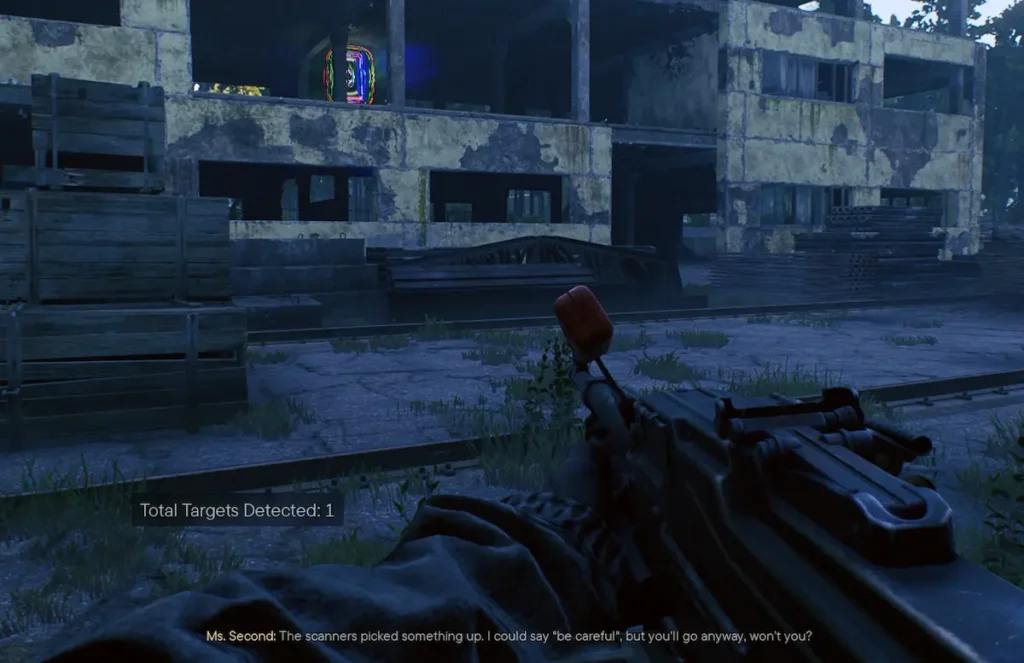
No crosshair and no ammo within easy reach
You end up firing fast because you have no idea how tough the thing coming at you actually is, and there’s no default aim point on screen unless you’re actually aiming down sights (ADS). Without a laser attachment, hip-firing is basically a guess.
Then you run out of ammo mid-fight and realize there’s no auto-reload. Reloading is manual, and I don’t know exactly how long it takes in seconds, but in the middle of a fight it feels like an eternity, and that’s exactly when you die. I also wasn’t sure whether or how melee worked when it actually mattered.
To make things worse, at the start of my first raid I hadn’t found any clear place to look for spare ammo, regular houses seemed to have none. I later discovered that car trunks are a good source, but if you don’t know that going in, the combination of a long reload and no resupply becomes a real problem fast.
One good detail, and a logic you have to learn on your own
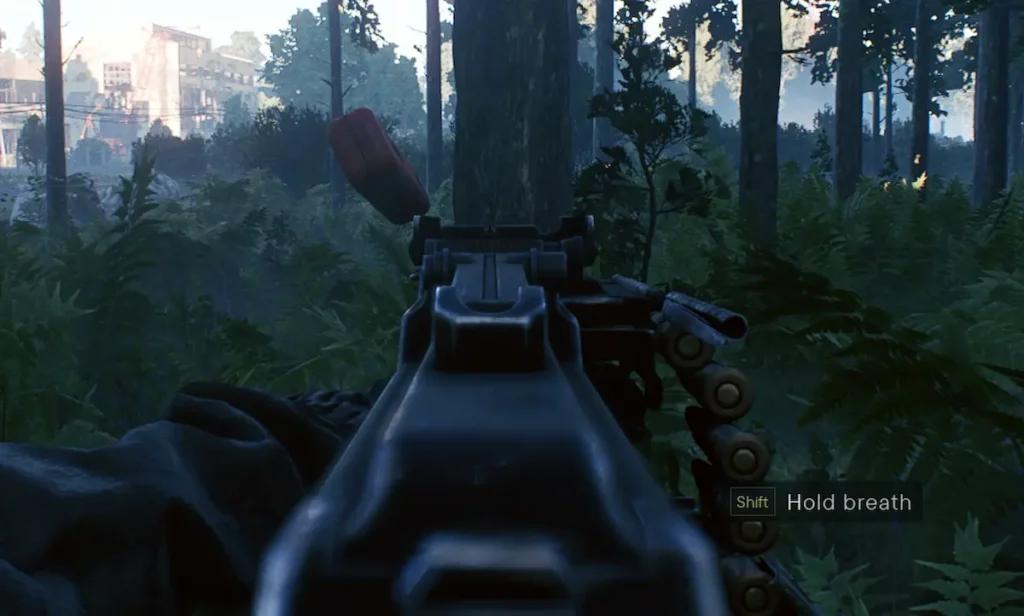
One detail I genuinely liked: zooming in to aim gives you the option to hold your breath to steady the shot, the same technique every sniper movie insists on before pulling the trigger. It’s a small thing, but it’s the kind of detail that makes the shooting feel deliberate rather than arcadey.
None of this turned out to be broken or unfinished, for what it’s worth. The lack of a default aim point and the slow, manual reload are both deliberate hardcore-design choices, closer to Escape from Tarkov than to a typical military shooter, and the atmosphere and monsters, statues included, constantly bring S.T.A.L.K.E.R. to mind.
The game even added laser sights specifically to make hip-firing more viable. It’s consistent design. It’s just never explained as intentional, so the first time it happens, it feels like something’s missing rather than something you’re meant to work around.
Extraction is its own added challenge
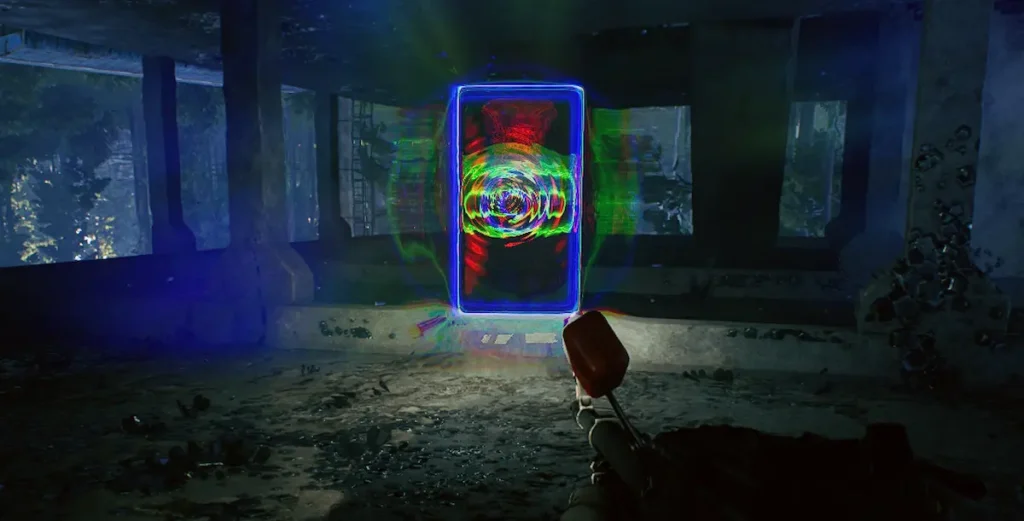
Getting out of a raid is a fight of its own. The extraction point was up high in our raid, which meant climbing there sideways along walls thanks to a gravity anomaly zone, one of the more genuinely interesting things the game does differently from other extraction shooters.
Once you reach the extraction area, a message warns you that you have five minutes before the zone collapses. There were houses with potential loot right there, and the timer made them feel more urgent to check, not less, which pulled us away from actually leaving.
The extraction platform itself has gaps, like a cracked road running vertically. Fall through one and you die instantly. I did exactly that, and ended up back at base with a message saying I hadn’t extracted properly, because I never actually reached the door. Dying before extraction, it turns out, means losing everything you were carrying that wasn’t in a safe container, confirmed directly on the game’s Steam page.
Half the map is often unavailable
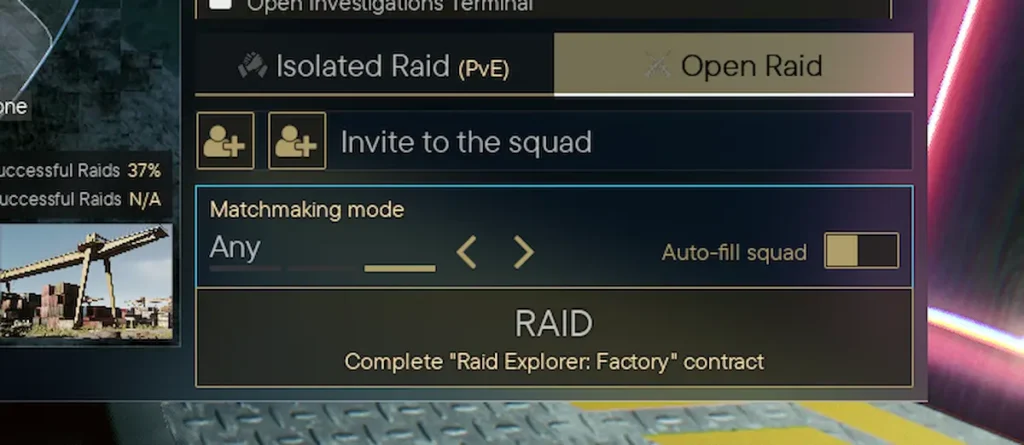
During one session, most of the raid list showed as “temporarily unavailable,” with only a single map actually playable at that moment, alongside a handful of Hired Ops and Faction Battles, some of those locked too. There’s a real rotation timer (“Next raids rotation in…”), but on top of that, many raids are locked separately because you need to complete a specific mission to unlock them.
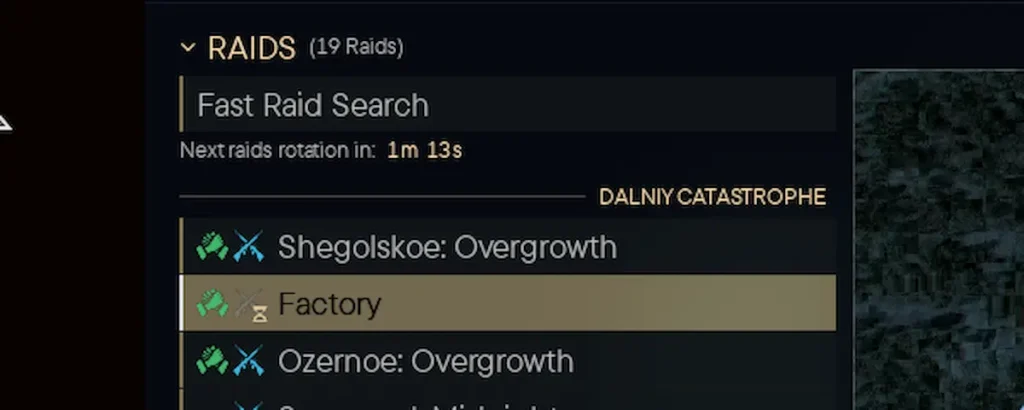
The problem is that nowhere does it explain where to find that mission, where you’re supposed to go, or what exactly you need to do. When I clicked a locked raid, the message just said “Successfully complete ‘Raid Explorer: Factory’ contract,” as one example, every locked raid seems to have its own condition like this, with no concrete pointer to the next step.
PvP: Hired Ops
Thrown straight into a match, with no orientation
Hired Ops is the dedicated PvP mode, with variants called Clash and Assault, though even after several matches I couldn’t find a clear difference between them, and no outside source seems to explain it publicly. At the start you’re simply dropped into a match with very little time to get your bearings, and picking a role (out of 3 pre-made ones) means choosing quickly, by guesswork, based on what you think might suit you.
If you’ve played other shooters before, the role names feel somewhat familiar from genre convention, but the game doesn’t explain anything at that moment, you don’t have time to read, and the next round is already starting.
You don’t know who’s an ally and who’s an enemy
You can’t see your teammates’ names, so you don’t know who to follow or support, and you end up trailing the group like a herd. Teams are told apart by colored armbands, blue for yours, red for enemies, but it’s not obvious at first glance, especially from a distance.
Time to kill feels odd: you can take a lot of body shots without dying, but a headshot kills instantly, so precision matters a lot more than volume of fire. Beyond precision, the armor and weapon tier each player bought with points also matters, so two players with the same aim can get completely different results just because of gear upgrades.
The objective, missed because of adrenaline, not because of the game
Here’s a correction to what I said at first: the capture objective does exist and is actually obvious, a ground-level tower with a large flame above it, hard to miss if you’re actually looking around. The problem was more on my end, I was so caught up in the adrenaline of the fight that I simply wasn’t looking where I should have been.
What still stands: every map seems to have its own orientation system, never reused elsewhere. On one map I noticed several blue arrows painted on walls, clearly meant as a direction indicator, on another, an ancient ruins style setting, some smaller street-sign type markers that seem to point somewhere, though it’s not clear where exactly. Either way you don’t have much time to figure them out, because you run into enemies almost instantly and the shooting starts. Gravity anomalies add to the confusion too: sometimes it feels like they don’t just flip me visually onto walls or ceilings, but actually teleport me, though I have no confirmation of that and don’t know how I’d tell the two types apart.
The in-match progression system, the big plus
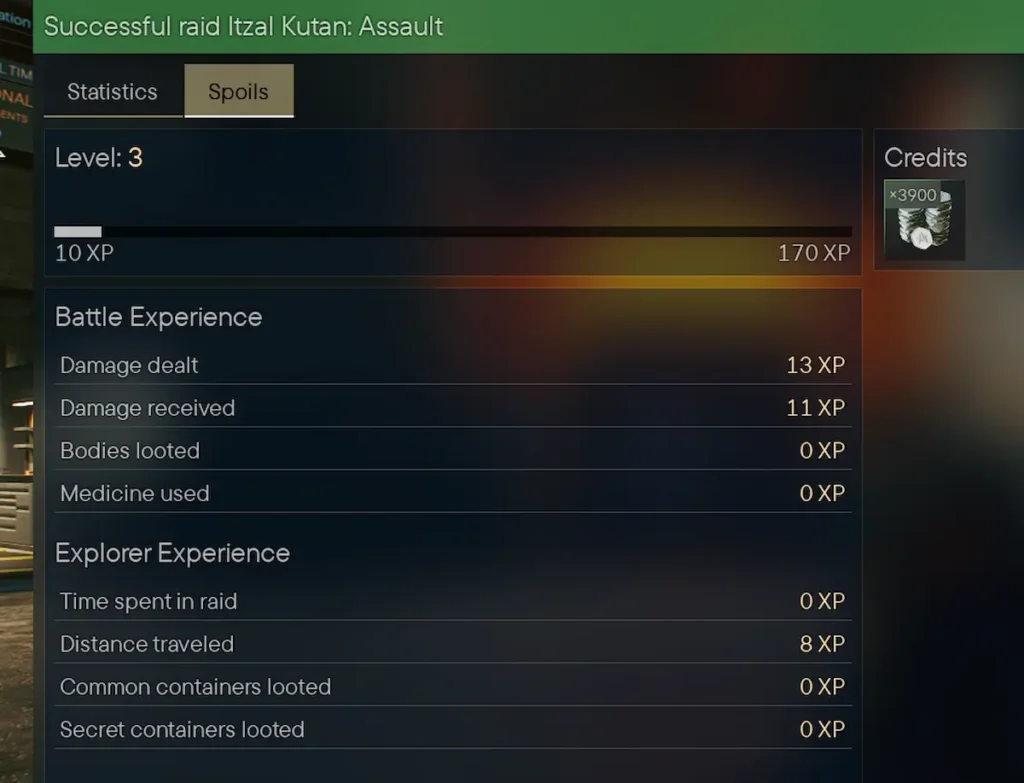
What I genuinely liked, despite everything above: the in-match progression system. You earn points from varied activity (kills, headshots, damage dealt and taken, distance traveled, containers looted), confirmed directly by the debrief screen, and those points buy better gear across five tiers: I at 0 points, II at 500, III at 1000, IV at 2000, and V at 3000, with the cost nearly doubling from one tier to the next.
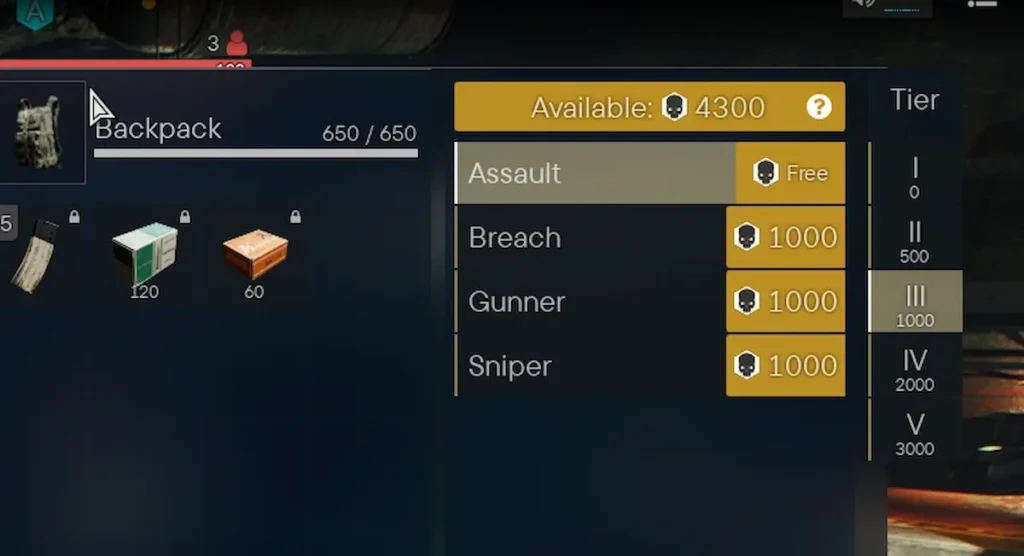
I reached level 4 and the difference felt massive: three enemies with no upgrades were shooting at me for the entire length of a full reload, without managing to kill me. It’s the kind of short-term, per-match progression system that genuinely rewards visible performance, unlike the rest of the game where progress is often confusing. If that gap between full gear and default were communicated more clearly from the start, I think it would completely change how the mode feels for new players.
But it’s not balanced at all
There’s also something worth flagging directly: it doesn’t seem balanced between levels at all. A fully upgraded player against a default one is a very uneven fight, hard for the latter to win. Even a headshot on someone at max level doesn’t guarantee a kill, because armor at the higher tiers absorbs a lot.
From my side, at level 4, it felt great, almost like a well-earned bonus, but it’s probably frustrating for someone still stuck with starting gear.
Other snags: team kills and fatal gaps
At one point I also noticed a double kill where one of the “bodies” turned out to be from my own team, and now I can confirm it for certain: yes, you can kill allies by mistake, it happened to me again. The problem is clear, from a distance it’s not obvious at all who’s an ally and who’s an enemy, the colored armbands don’t read well from far away. Something more visible would help a lot, like player names above their heads or a health bar colored blue for your team and red for enemies, so you instantly know who you have in your sights.
I also died once on my own, falling through some gaps on a platform, exactly the kind of “noob” death I’d already had at extraction in PvE raids. Round structure seems to run to 3 wins or losses, extending if tied, but I wasn’t able to confirm that for certain from outside sources either.
Overall, despite all this chaos, PvP is genuinely interesting, it’s something new for me and I like it.
Base: Refiner, Replicator, and the rest of the systems
Loot, refining, and where it all actually goes
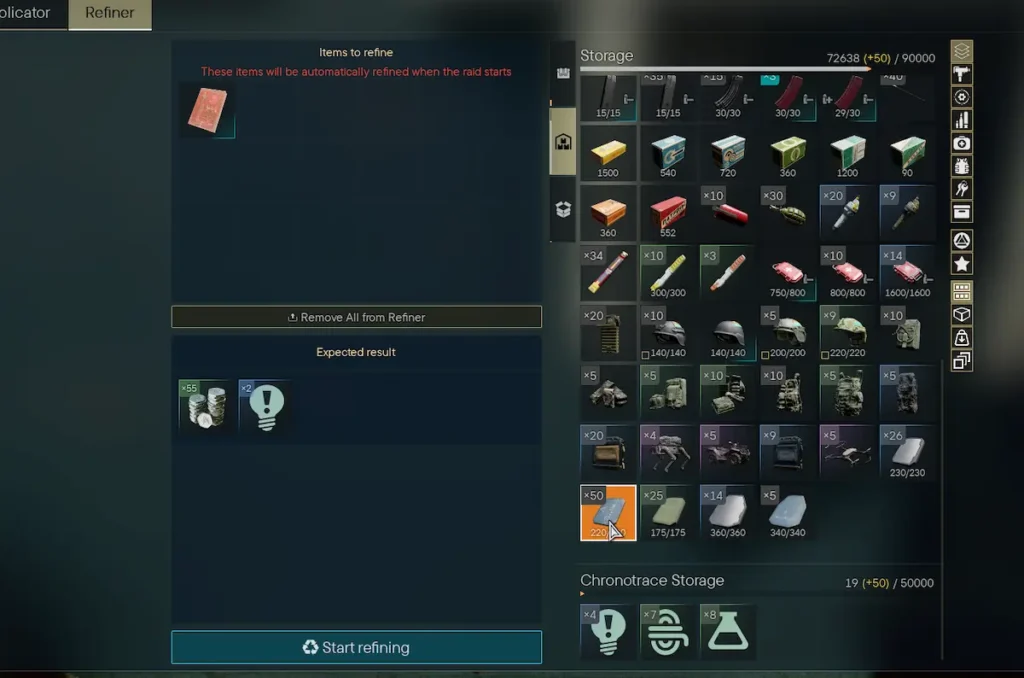
Back at base, refining loot is oddly satisfying once you understand how it works. An AI-2 First Aid kit, for example, shows you the expected result before you commit: 80 Credits, 1 Active Matter, and a mix of Fiber and Chemicals chronotrace.
A stack of useless books, paper junk, actually refines into more value than the medkit, mostly in Idea chronotrace, the rarest type. Quick Refine lets you queue several items at once and see the combined result before confirming, or you can drop everything back into storage if you change your mind.
What isn’t obvious is where any of this goes afterward. Credits and Active Matter land in Storage, which you’d expect, but chronotraces go into a separate Chronotrace Storage, tucked inside the Workshop under Body Sleeve Control, not somewhere I’d have thought to look on my own.
From there, the materials only become useful at the Replicator, also in the Workshop, where you spend them to restore an item’s replication charges or produce new gear entirely. None of this is explained the first time you refine something. You just end up with resources sitting somewhere, with no idea yet that a second menu, in a different tab, is where you actually spend them.
Rare items and systems nobody explains
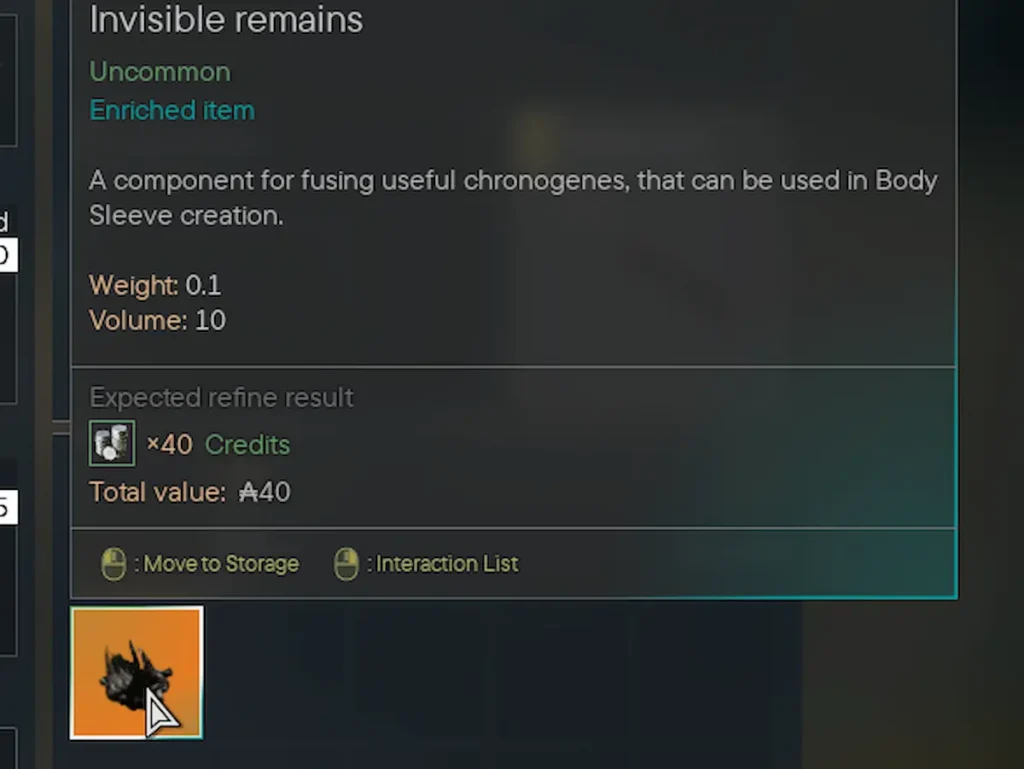
Partway through a raid, I looted something called Invisible Remains. A voice in the game, during the raid, warned me it could be important, so I stashed it in a safe container instead of risking it. That turned out to be the right call.
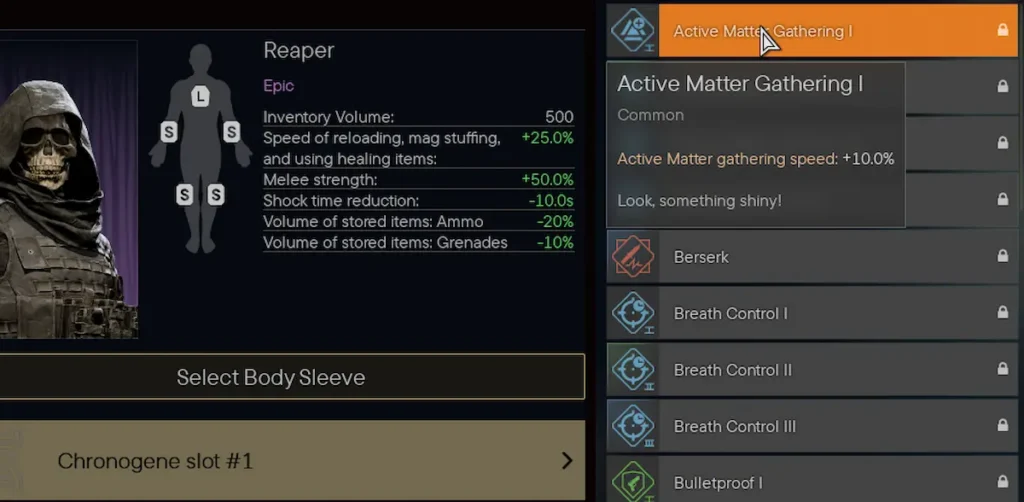
Its description only says it’s a component for fusing chronogenes for Body Sleeve creation, without explaining what a chronogene actually is: a permanent passive buff you slot onto your Body Sleeve, up to four at once, things like faster Active Matter gathering or bonus melee damage.
The remains come specifically from a monster called Invisible, and the resulting chronogene has to already be unlocked, mainly through Monolith progress or Investigations, before you can actually fuse it.
The Body Sleeve selection screen makes things even more confusing before it clears up: a long list of chronogenes, most of them locked, with no indication anywhere on that screen of how to unlock them.
What I did confirm is that you can keep several Body Sleeves geared up differently, one tankier, another leaning melee, and choose which one to use before deploying, depending on the raid. That’s a genuinely good layer of strategy. It’s just buried behind a screen that gives you very little guidance the first time you see it.
Proof the game can explain itself, when it wants to
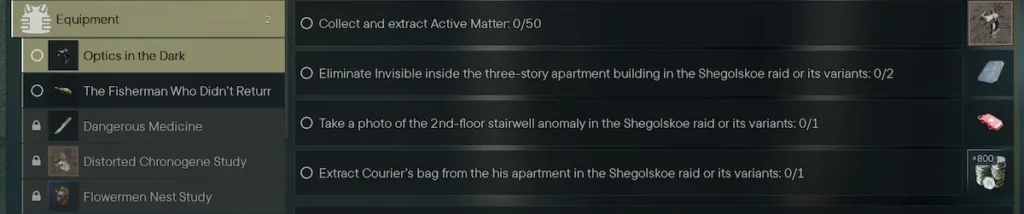
The Investigations Terminal is the counterexample to everything described above. Objectives there are laid out very clearly: exact progress numbers, the specific raid and location, the reward right next to the task. It’s genuinely well designed.
The problem is discovering that this terminal exists at all, and that it’s exactly the thing that connects all the locked weapons and chronogenes you keep running into elsewhere in the game. The information is clear once you’re looking at the right screen. Getting to the right screen in the first place is not.
The Monolith is just as clear, once you find it. At the Alpha level you see exactly what you’ve already received, things like 10000 Credits, access to a specific raid, a Storage space upgrade, plus a Replicator recipe. At the next level, Beta, requirements are displayed transparently, with a tooltip explaining each condition: a certain number of successful raids on specific maps, or the option to skip a requirement by paying Monolith tokens.
Here too the problem isn’t clarity itself, it’s that nothing else in the game actively points you toward this screen so you understand, from the start, that it’s essentially the overall map of your progress.
So what’s the actual goal here?
After several raids, I still wasn’t sure what I was working toward, beyond gearing up. There’s no clear main quest, no final boss, nothing pointing at an ending. That’s not something I missed, there’s no single-player campaign, and the developers have said clearly there won’t be one.
What story exists is scattered across raid briefings, Investigation texts, and details in the environment. Structurally, the whole game runs on repeating seasonal cycles called Harmonization Cycles, not a campaign with a finish line, as the game’s official site explains too. You raid, you loot, you upgrade, and the cycle resets and continues.
So why did I keep playing?
What kept me hooked
The graphics are fine. Not impressive, not bad, just fine. What actually kept me coming back was the maps, which feel different from other extraction shooters in a way I still can’t fully explain, the monster variety, including some that disguise themselves or vanish and reappear, and the wall-walking gravity anomalies, which genuinely add something new to the genre. I wanted to see what else the game had hidden.
What pushes me away
What pushes me away isn’t necessarily the amount of text in the menus. It’s that nothing unlocks progressively. Everything gets dumped on you at once, including a Storage tab that’s already overwhelming after your first two raids, instead of opening up gradually, feature by feature, as you actually level up and need them.
I have nothing against a short tutorial. I’d genuinely prefer one that covers just the essentials and flags anything unusual right from the start. What I don’t want is to feel like I’ve walked into a chemistry class the moment I open a menu, not because the information is wrong or poorly written, but because there’s so much of it at once that I don’t feel like reading any of it, even though I know I’ll need it eventually.
My score: 7.5/10
What I actually want from a session like this is simple: gear up, shoot, loot, upgrade, fight something bigger, eventually reach a final boss, and feel that payoff. Active Matter can deliver pieces of that, but it first makes you wade through a lot of unexplained systems.
Whether that’s a dealbreaker probably depends on what kind of player you are. If you already love the deep crafting and progression loops that games like Escape from Tarkov are built on, most of what frustrated me here will likely read as depth instead of a problem. If you want to drop in and understand what you’re looking at within the first hour, be ready to fight the menus just as much as the monsters.
Active Matter left early access and launched its full release on Steam, PlayStation 5, and Xbox Series X and S on September 15.

I’m passionate about books and video games. These two great passions represent, for me, a boundless universe where I can “escape” from reality whenever I need or want to. There are so many stories, worlds, and landscapes where I can instantly teleport that I don’t think a whole lifetime would be enough to explore them all (though it would be my greatest dream to be able to).