

Last updated on May 18, 2026
Every company talks about AI right now. Most of it sounds the same. When it comes from Sony Group CEO Totoki Hiroki and PlayStation chief Nishino Hideaki at a corporate earnings briefing, though, there are actual details worth paying attention to. The presentation they gave on May 8, 2026, covered how Sony plans to use artificial intelligence across gaming, film, and music, and some of it is more concrete than the usual executive talking points.
Here is what was actually said, stripped of the marketing language.
The Core Position: AI Amplifies, It Does Not Replace
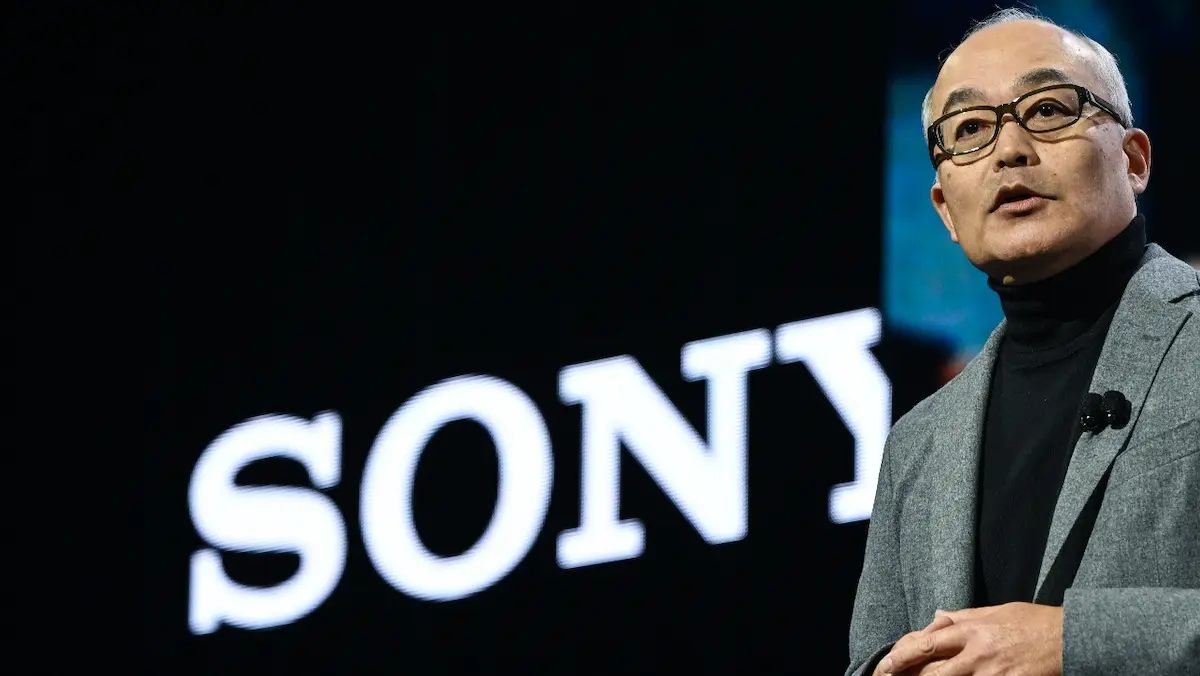
Totoki Hiroki set the tone early. “Human creativity must remain at the center,” he said. “AI is a powerful tool, not a replacement for artists or creators.” He described it as an amplifier for human imagination and a catalyst for new possibilities.
That framing is deliberate. The entertainment industry has watched other sectors use AI to cut headcount, and creators across gaming, film, and music are watching closely. Sony’s position is that AI handles the repetitive, time-consuming parts of production so that the people doing creative work can focus on what actually matters.
Whether that holds in practice is a separate question. For now, it is what the company is committing to publicly.
Mockingbird: The Tool Already Running in First-Party Studios
Nishino’s portion of the presentation was more specific. He described a proprietary generative AI tool called Mockingbird, which automates facial animation by processing performance capture data. A process that used to take significant time and manual work now happens in a fraction of that, according to Nishino.
Mockingbird is not experimental. It is already in use at Naughty Dog, the studio behind Intergalactic: The Heretic Prophet, at San Diego Studio, and at others across Sony’s first-party network. It was even used in MLB The Show 2026.
Beyond facial animation, Nishino also cited AI being applied to hair animation and racing agent simulation as additional examples of where the technology is already active inside PlayStation’s development pipeline.
The Bandai Namco Partnership
Sony is not limiting this work to its own internal tools. The company has launched a collaborative pilot initiative with Bandai Namco Holdings, the parent company of the studio behind Elden Ring, Dark Souls, and Tekken, to explore how generative AI can support creators in video production.
Totoki said the pilot has already produced substantial gains in speed and productivity per person. He also acknowledged limitations, specifically around consistency and controllability, and said Sony has developed approaches to address those using fine-tuned models built on proprietary data. The goal is reliable output in intended styles at a cost level that makes wide deployment viable.
What Sony Pictures and Sony Music Are Doing
The $50 million figure that circulated after the presentation relates to Sony Pictures, not PlayStation specifically. That investment covers production planning, content protection, enterprise productivity, data analytics, innovation, and 3D conversion across the film arm.
Sony Music is taking a different approach, pushing for an industry-wide standard to label AI-generated content across platforms. That is less about internal tooling and more about how AI-created music is identified and disclosed to listeners.
The Part That Has Players Paying Attention
Nishino said something that generated a reaction beyond the investor audience. He suggested that AI would enable a “meaningful increase in the volume of content” on PlayStation platforms. The logic is that lower production barriers mean more games can be made. The concern some players have is what that increase in volume looks like in practice.
His follow-up was measured: “The vision, the design, and the emotional impact of our games will always come from the talent of our studios and performers. AI is meant to augment their capabilities, not replace them.”
It is also worth noting that AI is already central to the PS5 Pro’s PlayStation Spectral Super Resolution upscaling tool, which was recently updated and now supports a large number of first and third-party titles.
The Bigger Picture
Sony is not making a bet on AI as a future possibility. It is describing something already in use across its studios, being expanded through partnerships, and being positioned as infrastructure for whatever the next generation of PlayStation development looks like. The question the industry is watching is whether that infrastructure ends up serving the people making games or replacing them. Sony’s answer, for now, is the former. The proof will be in the games.

I’m passionate about books and video games. These two great passions represent, for me, a boundless universe where I can “escape” from reality whenever I need or want to. There are so many stories, worlds, and landscapes where I can instantly teleport that I don’t think a whole lifetime would be enough to explore them all (though it would be my greatest dream to be able to).